- +1 919 200-0292
- info@antennatestlab.com


Far Field Testing
Far Field Testing
Two Antenna Testing Methods
Evaluating antenna performance relies on capturing precise radiation characteristics to verify a design’s real-world behavior. RF test facilities typically employ either far-field or near-field testing methodologies, depending on the antenna’s electrical size and the physical constraints of the testing environment. The fundamental difference between these two methods lies in the measurement distance and whether the final radiation characteristics are directly observed or mathematically derived from localized data.
Far Field Testing
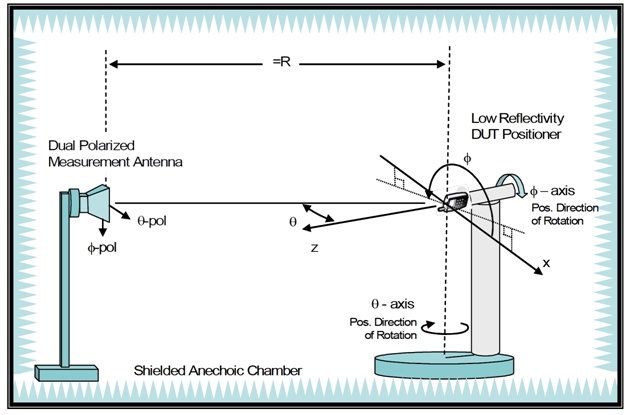
Far-field testing provides a direct, non-simulated measurement of an antenna’s operational performance by capturing radiated fields from a significant distance. In a standard evaluation, the antenna under test is mounted on a two-axis positioner and driven by swept Vector Network Analyzer (VNA) sources. A broadband receiving antenna, typically a quad-ridge horn, measures the response from the opposite end of an anechoic chamber. Maintaining a spatial separation—often 3 meters or more—ensures the electromagnetic wavefront is fully formed and planar by the time it reaches the receiving chamber antenna. Because this approach relies purely on direct observation rather than predictive models, it accurately quantifies unexpected physical anomalies, including unintended feed-line radiation, chassis coupling, and other environmental distortions that occur near the radiating element.
Near Field Testing
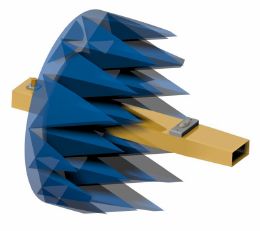
Smaller chambers sometimes use “near field scanning”. In this method, a probe (like this one shown) is scanned near and around the antenna under test. The probe results are run through a mathematical algorithm to predict the far field pattern of the antenna. This method may miss many real world antenna effects such as feed-line distortions. It can be less expensive, and does not require a large anechoic chamber. It is well suited to large aperture antennas that have challenging far field requirements.
Let’s Get Started !
Ready to get your antenna project underway … then contact us and let us help. A qualified antenna testing company will get your project on track.
Glossary & Terminology
- Anechoic Chamber: A shielded room lined with radiation-absorbent material designed to completely eliminate electromagnetic wave reflections, simulating a free-space environment for accurate RF measurements.
- Vector Network Analyzer (VNA): A critical piece of RF test equipment used to measure the network parameters of electrical networks, specifically the scattering parameters (S-parameters) that define how RF energy passes through or reflects from an antenna system.
- Quad-Ridge Antenna: A type of broadband horn antenna featuring four internal metallic ridges. It is highly valued in testing environments because it can maintain consistent performance over a very wide frequency range and measure dual orthogonal polarizations simultaneously, from the same physical location (phase center).
- Far-Field (Fraunhofer) Region: The spatial region sufficiently far from a transmitting antenna where the angular field distribution is essentially independent of the distance from the antenna, and the electromagnetic waves act as plane waves.
Frequently Asked Questions
How do you determine the minimum distance required for true far-field testing? The boundary for the far-field region is typically calculated using the Fraunhofer distance formula: R = 2D² / λ, where D is the maximum physical dimension of the antenna under test and λ (lambda) is the operating wavelength. For the measurements to be considered accurate “far-field” data, the receiving antenna must be placed at or beyond this calculated distance R.
Why might feed-line radiation go undetected in a near-field scanning setup? Near-field probes sweep across a strictly defined mathematical boundary (typically planar, cylindrical, or spherical) close to the radiating element. If the coax cable or feed-line radiates energy outside of this specific scanning envelope, or if the energy is coupled in a way that doesn’t intersect the probe’s path, the mathematical transformation algorithm simply lacks the raw data to include those distortions in its final far-field prediction.
When is near-field testing preferred over far-field testing? Near-field testing becomes practically mandatory when evaluating electrically large, high-gain antennas (such as massive phased array radar panels or satellite dishes). For these devices, the required Fraunhofer distance could exceed hundreds of feet. A near-field scanner allows engineers to accurately characterize these large apertures within a compact, cost-effective footprint.